Posts

Showing posts with the label skin biophysical properties

80.Restricted ingredients in cosmetic and skin care products

Image
Restricted ingredients in cosmetic and skin care products by regulation. Ingredient Potential toxicity Hexachlorophene Neurotoxic effects Ability to penetrate human skin Mercury compounds Accumulation in the body Skin irritation Allergic reactions Neurotoxicity Bithionol Photocontact sensitization Halogenated salicylanilides Photocontact sensitization Chlorofluorocarbon propellants Hazardous to human health Chloroform Plausible carcinogenicity Vinyl chloride Plausible carcinogenicity Zirconium-containing complexes Lung toxicity Methylene chloride Plausible carcinogenicity help to find the specific skincare product ingredients by "skin+" App.

27-.wrinkles, fine wrinkle and coarse wrinkle

Image
There are two kind of wrinkles. They are fine wrinkle and coarse wrinkle . The wrinkles are caused by different reasons.  Fine wrinkle The Keratinocyte reduces the cell divisions, and has longer Keratinization process. The Stratum corneum is dry Coarse wrinkle The change of Elastic fiber, collagen, reticulum fibers in dermis. The skins loose the elasticity.  The following is the structure of dermis. There are some fibers, materials, cells, and organ. When they become old, that will cause wrinkle. Structure of dermis 1.        Fibers Elastic fiber, collagen, reticulum fibers 2.        Basic material Glycoproteins, acid mucopolysaccharides, neutral mucopolysaccharides, etc. 3.        Cell Fibroblast, mast cell, macrophage, etc. 4.       Organ blood capillaries, nerves, glands, and hairs. --------------------------...

26-.How do the skin age? Intrinsic aging and extrinsic aging

Image
Intrinsic aging and extrinsic aging Aging can be divided into i ntrinsic aging and extrinsic aging. Many people will concern about their facial skin, especially woman and girls. Many people try to apply cosmetics and skin care products to make their skin younger, even plastic operation. How do the skin age?     Intrinsic aging It means the function of skin ages by their Genetic Inheritance. The functions decay with lack of h ormones. The cells and water decrease and also glands reduce to excrete lipids. The skins will be dry, not elastic, and well looking. Fertilized egg already has cell divisions and has skin from the eighth month. The skin of new born baby is very thin and transparent. The fibers in dermis will grow with better elasticity as they grow to teenager. After 30 years old, the excretion of hormones starts to reduce and cause less cell diversions. The skin is coarse, especially after the climacteric.       Extri...

25-.What do NMF do?

Image
NMF ,Natural moisturizing factor Natural moisturizing factor is a combination of hydrating molecules.  Natural moisturizing factors are the substances excreted from skin cells themselves.  It is found in the skin cells of the epidermis.  NMF ( Natural moisturizing factor ) can absorb and adjust water in skin.  If the skin is too dry, the body would work to upregulate its NMF(Natural moisturizing factor) by drawing in more moisture. Most of them exist in stratum corneum and dominate 15-20%. The substances include 40% Free amino acid 12% Sodium 2-pyrrolidone-5carboxylate, PCA.Na 12% Lactate 7% Urea 6% Chloride 5% Na+ 4% K+ 1.5% Mg++ 1.5 Ca++ 1.5% NH 3 ,Uric acid, gluvosamine, cretinine 0.5% phosphate 0.5% citrate 8.5% Unknown subsatnces ----------------------------------------------...

24-.What is Transepidermal water loss (TEWL)?

Image
What is Transepidermal water loss (TEWL)?It is the indicator to evaluate your skin hydration. How do you understand the water barrier function of human skin? Try the transepidermal water loss (TEWL)indicator. It is the way to monitor the skin hydration. Water passes from inside a body through the epidermal layer to the surrounding atmosphere via diffusion and evaporation processes.   It (TEWL) would vary with the skin barrier (wounds, scratches, burns, exposure to solvents or surfactants, extreme dryness), the conditions of weather such as humidity, temperature, season, and moisture content of the skin.  The continuous process(TWEL) is difficult to control artificially and it is an indicator of skin conditions about hydration. Transepidermal water loss indicates the condition of skin at the moment. For example, when the climate is dry, TEWL value increase. When we has little water in the skin, TEWL value increases. To sum up, Any thing that assaults or insult...

23-.The skin Adnexa_gland

Image
The skin Adnexa Hair Nail Sweat gland Eccrine sweat gland Skin has 250 millions of Eccrine sweat glands and can excrete sweat directly out of skin. The distributions almost are near palms, soles, underarms, and forehead. The excretion will be adjusted by emotion and temperature. The excretion will start at dermis and open at epidermis. Apocrine sweet gland It is larger than eccrine sweat gland and from dermis. It locates at the   underarm , areola   and nipples of the breast,   ear canal, eyelids, wings of the nostril, perianal region, and some parts of the external genitalia. The smell of the odor is the interspecific relationships of microorganisms when sweats excrete to the epidermis. sebaceous gland They locate at the   face   and   scalp, but also on all parts of the   skin   except the   palms  and soles. They will excrete lipids with cell divisions. ---------------------------------------------...

22-.The nail structure

Image
The skin Adnexa Hair Nail Sweat gland sebaceous gland   nail structure nail matrix, nail root, proximal matrix, nail plate matrix nail plate, nail body nail bed, distal matrix, nail bed matrix white lunula proximal nail fold eponychium, cuticle hyponychium  Nail has similar function of the  Stratum corneum in skin. Because this part does't have  Melanocyte  i n stratum basale, the nail is transparent. The nail care is like the skin care should to prevent damage the  Cormeocyte which is appearance of nail. As it is damaged, It will lose the protection and need   more time to recover than skin. ----------------------------------------------------------------------------------------------------------- help to find the specific skincare product ingredients by "glamskin" App

21-.Do you know hair has period of life?

Image
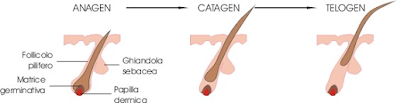
Do you know hair has period of life? Hairs have period. The steps are above.  otherwise, there are many reasons that will influence the period.  l    90% of hairs are in anagen, 1-2% are in catagen, and 10-14% are in telogen. l    The period depends on the hair follicle of body parts. For example, eyebrows are 4 months, and the  hairs on head are there to four years. The period also determines the length of hair. l    The period is also influenced by the environment of hairs such as epidermal growth factor, etc. The hairs fall off also by the gene. The hairs will be from terminal hairs to vellus hairs ----------------------------------------------------------------------------------------------------- find the specific skincare product ingredients by "glamskin+" App

20-.Why do you have gray hairs?

Image
Why do you have gray hairs? The reasons that cause gray hairs l    oxidative stress   Inappropriate production of oxidants will intricately connect to ageing and life Span such as the cell in hairs l    Lack of melanocyte in keratinocytes. l  Melanocyte can not excrete melanin The chemical properties of hairs l    The main component is keratin included eighteen amino acids. l    Hairs contain 12-13% water (25 0 c, RH65%) l    Hair has Melanocyte to excrete melanin and dominates 3%. l    Hair has lipids and depends on individuals. Most of all are free fatty acids and dominate around 1-9%. l    Hairs have trace elements such as Cu, Zn, Ma, Ca, Mn, P, and Si. The physical properties of hairs The hair has cysteine, so hair is strong and also has extension. Amino acid Keratinocyte of hair(%) Keratinocyte of epidermis(%) Glycine 6 6 Alanine ...

19-.Do you understand your hair structure?

Image
The structure of hairs Hair bulb Hair root: Hairs in the skin Hair shaft Hairs out of skin Hair follicle Hair shaft Medulla Cortex Cuticle Structure of hairs Hair has a shaft above the skin and a root embedded in the skin. The basic components of hairs are keratin, melanin and trace quantities of metallic elements.    If hairs are in the period of growth, they will remain in the follicle. During the resting stage, hairs will be sloughed from the skin. Cuticle Cuticle is the outer layer of hair shaft. There are three structures in the cuticle. They are coronal, spinous, and imbricate. Only the imbricate type is belonged to human. The others are only found in animals. Medulla The medulla is a central core of cells in hairs. It will be amorphous in appearance in human. The structure will be in there types. They are fragmentary, broken, or continuous. Cortex The cortex is the main body of hairs. It conta...

18-.What kind of hairs do you have?

Image
The skin Adnexa Hair Nail Sweat gland sebaceous gland Hair The types of hairs Lanugo hairs Hairs are soft and thin. They only happened to the newborn baby.  Vellus hairs They are only 1-2cm height without melanin. They don’t have sebaceous gland and won’t excrete lipid. Terminal hairs They are coarse and long hairs with glands. Especially on head, arm, and leg.     Hair Hairs have their life. They continue to grow, fall off, and new born. It can be defined to 3 periods. They are Anagen, Catagen, and Telogen. It falls off 70-120 hairs every day. Dermal papilla It is the recess of hair bulb. There are cells next to edge to get the nutrition from blood capillaries. The cell divisions will become new hairs. If cells are damaged, the hairs won’t grow any more.   --------------------------------------------------------------------------------------------------------- help to find the specific skincare product ingr...

17-.What is skin (9)? subcutaneous tissues

Image
subcutaneous tissues hairs and glands connect subcutaneous tissues fulfill a lot of blood vessels and adipocytes. It not only storages fat but also provides the cushion for impact. The volume, thickness, and the structure will be influenced by hormone.  ----------------------------------------------------------------------------------------------------------------- help to find the specific skincare product ingredients by "glamskin" App

16-.What is skin(8)? dermis

Image
The skin has three layers. They are epidermis, dermis and subcutaneous tissues . Dermis It consists of connective tissue and provides elasticity of the skin.   Its thickness depends on the body part. The average is around 1-4mm. eyelid is only 0.3 mm. back , palms and soles may be more than 3mm. Structure of dermis 1. Fibers Elastic fiber, collagen, reticulum fibers 2. Basic material Glycoproteins, acid mucopolysaccharides, neutral mucopolysaccharides, etc. 3. Cell Fibroblast, mast cell, macrophage, etc. 4. Organ blood capillaries, nerves, glands, and hairs The structure could be divided into 2 types. They are papillary dermis and reticular dermis. papillary dermis l    Close to the epidermis, the thickness is 1/5 of dermis thickness l    Consist of low density connective tissue l    collagen fibers and elastic fiber with many capillary, is called subpapilary plexus the low density is easy for the phago...

Popular posts from this blog

79.The roles of Vitamin in skin

80.Restricted ingredients in cosmetic and skin care products

78.AHAs (alpha hydroxy acids) and BHAs (Beta hydroxy acids)